Don’t Argue with Corvids
Winter Issue '24 - Online Shop
You are a poet, a crow told me, coal against zinc on the sky.
You hear rhymes embedded in everything said, their texture like boulders in sand.
Normal folk walk, barefooted even, blithe to the grains and the nuggets.
But you, tenderfoot, you sensitive sole, you mince over pebbles and stones.
What crows see is obvious, if you’re a crow. Is poetry that way for poets?
If verse disinters from the earth as I stroll, is that unique? Is it common?
I’m wary of crows, though, of ease, and of leanings. I know what precious things cost.
Doesn’t mining take effort? Doesn’t gain come from loss? Won’t metal be strengthened by fire?
That’s what I thought, at least up until now, shod and be-socked on the bluff.
But the sky is a slate and my heart’s made of chalk, I long to be barefoot in sand.
A raven bird told me, cave to your nature! Transmute your passions to words!
And now, as my autumn starts hinting at winter, I’m starting to think that I should.
Who knows what the crow knows? His wisdom is old. And this way’s how I walk, anyhow.
So, I’ll exhume the rhythms from humus and loam and offer them, free, to the crow.
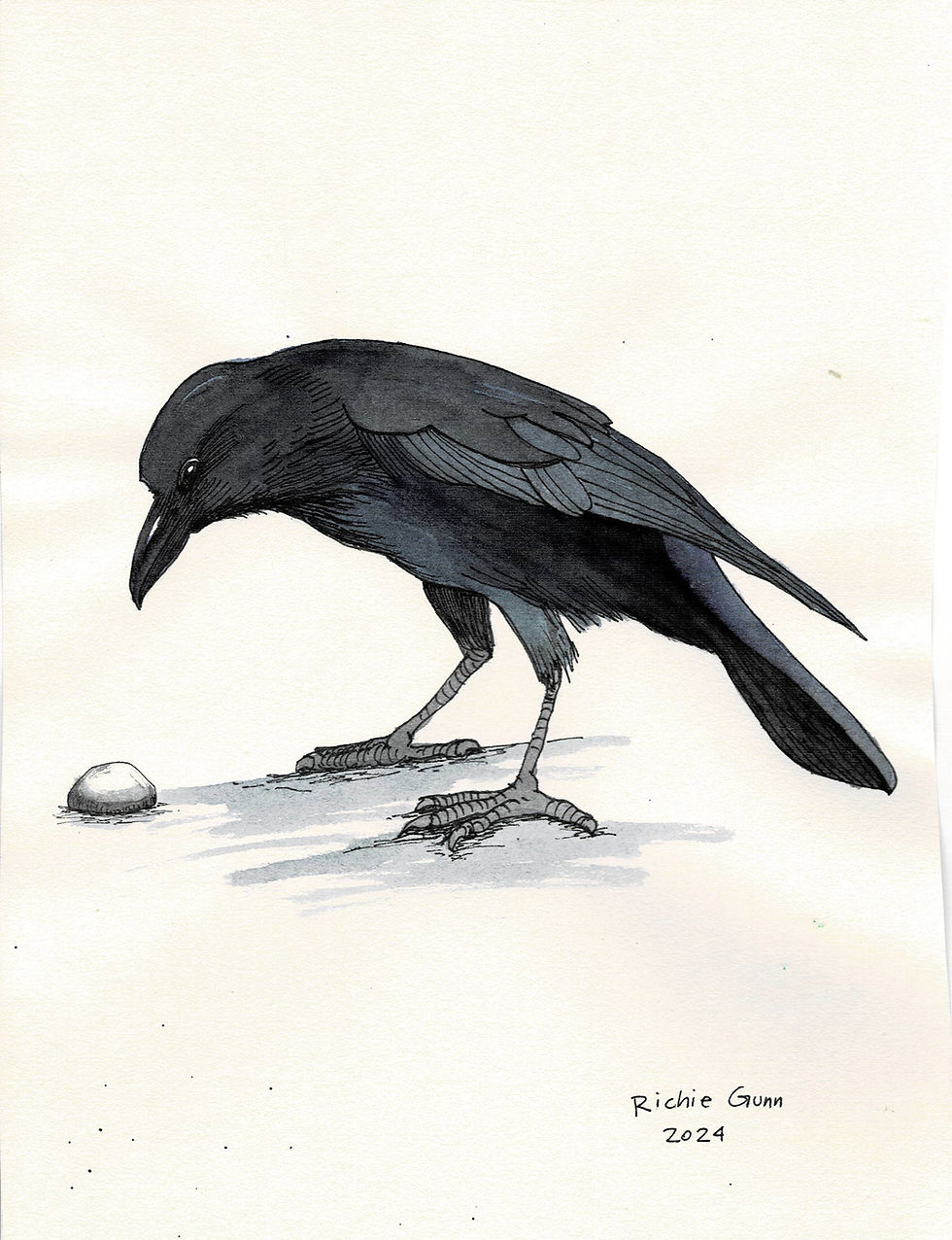
This is a poem about my ambivalence towards poetry, and about my wariness of things that come with little effort. It’s also, of course, about geology and birds and my pathetically sensitive feet. And, obliquely, about my father.
He has a bloodhound’s nose for rationalization, my dad, and he doesn’t value art for its own sake. If you choose a path he deems easy, no matter how strong your rationale, he will conclude that you chose it for its ease. If you choose a path that seems artsy, his judgment of your success will be economic. Mom read us kids stories and sang us songs. Dad quizzed us on balance sheets and income statements. In the private high school we attended, he declared a concentration in “Business Studies” to be compulsory. Art, music, romance languages? All optional.
I don’t trust money very much, though, and my inherent disposition is artistic, not mercantile. But I love my dad, and I want his approbation. The tension between my innate creative leanings and my father’s inclination towards things that feel laborious to me, like numbers and business—and his focus on money—has manifested in my life as an oscillation between two very disparate life paths. That is, the life of the bohemian slacker on the one hand (my jam), and that of the neo-capitalist go-getter on the other (my dad’s). I laughed off my scholarly success in writing assignments, and my professors’ suggestions of oil painting as a career. Instead, I put on an investment banker’s suit and went to work on Wall Street. After some despairing weeks in New York, I ditched the suit and retreated to Montana and the heady inspiration of The Rockies. There, copywriting jobs started falling in my lap. I sat in my ski bum shack and wrote words for a living. But I couldn’t believe people would pay me for that; it didn’t feel burdensome enough. Viewed through my father’s lens, it felt too much like cheating! So, I went to law school and then into business.
My dad trained me to interrogate my inclinations, to discount the simple and to prize the arduous. To quote the poem, “Doesn’t mining take effort? Doesn’t gain come from loss? Won’t metal be strengthened by fire?” So, carrying my dad’s voice in my head, I’ve skirted around what felt effortless to me, and leant into whatever felt grueling; instead of inventing poems, sculpting stories, or marshaling text, I do the hard business of wrangling staff, laying out marketing plans, and crunching financials most of the time. Thanks to Dad, I got good at a lot of really hard things. After more than half a lifetime, though, I’ve learned that if you get good at something, you’ll end up doing it—even if it’s not what you love.
What I love is to create. I love languages. I love language. I love words. Their sounds, their rhythms, their multiple overtones and connotations. The way senses and meaning refract and coalesce between one language and another. I love the process of quarrying my personal lexicon to unearth the most perfect word, le mot juste, la palabra perfecta. Words are my natural milieu. Rhythms and rhymes are, too. I hear (I see!) the cadences and neuronal intersections of words as they emerge from the page, from my mind, from your lips, from the stones and the birds. Juxtapositions of meter and of rhyme, archetypes of alliteration, observations of irony, coincidence, and metaphor—they hit me over the head. It’s not effortful at all. In fact, I can’t help it. I get lost in the pleasure of signification, of meaning, of creating. I “hear rhymes embedded in everything said, their texture like boulders in sand.” This is my innate flow and doesn’t feel arduous at all. It’s satisfying, like finding Petoskeys is satisfying. It’s addictive, like making fresh tracks in powder. I always want more. That’s a lot of what this poem is about.
But if things that come easy have low value, and if gratuitous art has lower value still, then poetry must be the absolute bottom of the well. Because, to me, poetry feels, if not effortless, then at least intuitive—and I’ve never heard of a rich poet. (To paraphrase the poem, digging your product from the ground and giving it away, free, to a bird, does not sound like a great money-making proposition.) I think this helps explain why, in light of my father’s worldview and despite my love of words, I have never given myself permission to embrace the identity of a writer—much less that of a poet. And although composing a poem is an intrinsic pleasure for me, and sometimes happens almost spontaneously, I have no idea whether this phenomenon is rare or common or whether the product is any good at all. That is, “[i]f verse disinters from the earth as I stroll, is that unique? Is it common?”
[Side note: I know that, for many people, writing is not easy or intuitive, and that for these folks, writing is the task they sweat over, the one they have to work at. This alone should probably have tipped me off long ago that leaning into writing would have been a great choice for me. But I think I was too engrossed in my own self-abnegation to take note. In the words of the poem, I was “shod and be-socked on the bluff…long[ing] to be barefoot in sand.”]

My father now suffers from memory loss. When I visited him last winter, it was a tender and loving time; he’s become somehow softer these days, his shadow less stark, his judgment less compelling. This visit made me contemplative, made me wonder how long I have before I, too, enter a diminishing world of bewildering interactions, of contracting conversations, of forgotten phrases, of unfinished business. I had always figured that there’d be time, at some later date, to indulge my creative impulses. But spending time with my dad, and feeling my own body’s “autumn start… hinting at winter,” some urgency is starting to set in. On leaving my father’s house that evening, I encountered some crows. One of them was particularly strident, and it seemed to be speaking directly to me.
“You are a poet,” it called (it cawed), “like it or not. And you better get a move on.” That’s what prompted me to write this poem.
BIO
Pete Kirkwood is a reluctant entrepreneur who loves to create with words and with his hands. He loves adventure travel with his family, he does improv, and he ponders how we can do a better job of crafting communities that maximize culture-wide well-being. His career path has included stints as a garbage-man, investment banker, roofer, in-house counsel, ski instructor, copywriter, and publican.
Winter Issue '24 - Online Shop


