Swimming, Sighting, and Navigating the Waters of Life

Fall Issue '24 - Online Shop
“Finally, the lessons of impermanence taught me this: loss constitutes an odd kind of fullness; despair empties out into an unquenchable appetite for life.” - Gretel Ehrlich
If you’ve ever seen the Mackinac Bridge from its underside, it’s intimidating. Not many people have, but those of us who know what the 200-foot-high bridge looks like as her green stanchions rise from the depths of two of Michigan’s most formidable Great Lakes also know how the water underneath her appears as it fades from clear near the shore to murky near the main channel. The first time I observed the water that flows through the bridge’s massive underbelly from that angle, I immediately recognized it as a profound metaphor for life; in an instant and without warning, things can go from calm to unsettling.
The Straits of Mackinac are four miles across, an expanse that separates Michigan’s Upper and Lower Peninsulas. I’ve swam it twice, and in doing so followed passages shared by important people in my life. In 2015, I crossed south to north, traversing the route my grandfather and father did on their way towards Mass City and deer camp, and then again in 2019, when I swam north to south, tracing the path once traveled by my grandmother.

The endeavor of swimming the Straits, admittedly, is not a small feat, complicated by the distance, the current, and the cold water. It was just about at the confluence where Lake Michigan and Lake Huron meet when it occurred to me that I was just a speck hidden between waves, working tirelessly to breathe between the crests and kick and pull against the current. Even though I kept repeating a mantra to myself—“I can do hard things. I am strong. I am able.”—throughout the two-and-a-half-hour swim, I often felt like I was moving backwards, making no progress against the expansive, rough waters.
My father, a gifted writer who often would share his feelings of pride or gratitude for his children via letters, told me exactly what he thought of my 2015 swim when he sent me a letter afterwards and said, “unique people do unusual things just because they could.” In this same letter, he told me how my grandmother crossed the straits on a coal-fired car ferry she occasionally got to captain, and how my grandfather would wait in lines more than three miles long just to cross the straits to go deer hunting, and how he himself used the ferries before there was a bridge to cross. When he signed off, “We are so proud of you,” it felt like the “we” he was referring to spanned generations of equally unique, brave, able, and strong people, and—as with most things my father told me—I didn’t take it lightly.
I buried my dad on October 18th, 2023. Ten months earlier, my mother had passed away unexpectedly. Thirteen days after laying my dad to rest, I had surgery to remove a large, non-cancerous but nonetheless painful and inconvenient mass in my calf. As I lay in bed recovering from the surgery and still reeling from the back-to-back deaths of my parents, all I could think about were my swims through the Straits of Mackinac. I would close my eyes and see the calm, peaceful water lapping against the shore, and then suddenly, the water would become choppy, dangerous, and dark.
After my mom passed, I spent the majority of 2023 traveling across Michigan, trying to bridge the gaps in my dad’s care. My dad and I had always been close, even when space or time separated us, and in his company, I found quiet calmness; he was a life raft, buoying me through whatever trial or tribulation I was going through, telling me that I was enough exactly as I was. He was gentle and thoughtful and kind, but also a strong and well-respected leader in his community and in our family. The cause of his death, after a month in Hospice care, was heartbreak, caused by the passing of my mom and his wife of 55 years, and that in turn broke my heart.
At the same time, the mass in my leg brought my own life and my own mortality sharply into focus. Justin, my husband, watched over me with loving patience as I navigated my fear and anxiety over my diagnosis and healing, while also attending to our children, Gretel and Thor, as they approached launch periods in their young lives—Gretel, heading off to college, and Thor, starting high school. I hated that grief and worry were camped out in my house like guests who had overstayed their welcome. For months, I felt weak and drained, and it reminded me of how I would feel when I would take breaks in my Straits swim, treading water to simply stay afloat until I could muster the energy for the next part of my swim.

Open water swimming, much like healing, is an unusually long exercise in perspective. When I swam in enormous bodies of water, I would employ a technique called “sighting.” Sighting is when a swimmer lifts their head high enough and long enough to pick a point, then puts their head back down and swims. Sighting every ten strokes allowed me to modify my course throughout my Mackinac swim, moving from one goal—like a bridge abutment or a spot on shore—to the next. Focusing on one small point until it was time to focus on the next kept me systematically moving myself closer to the end of the swim. Often it was only until I looked behind me that I could see the progress I was making in front of me.
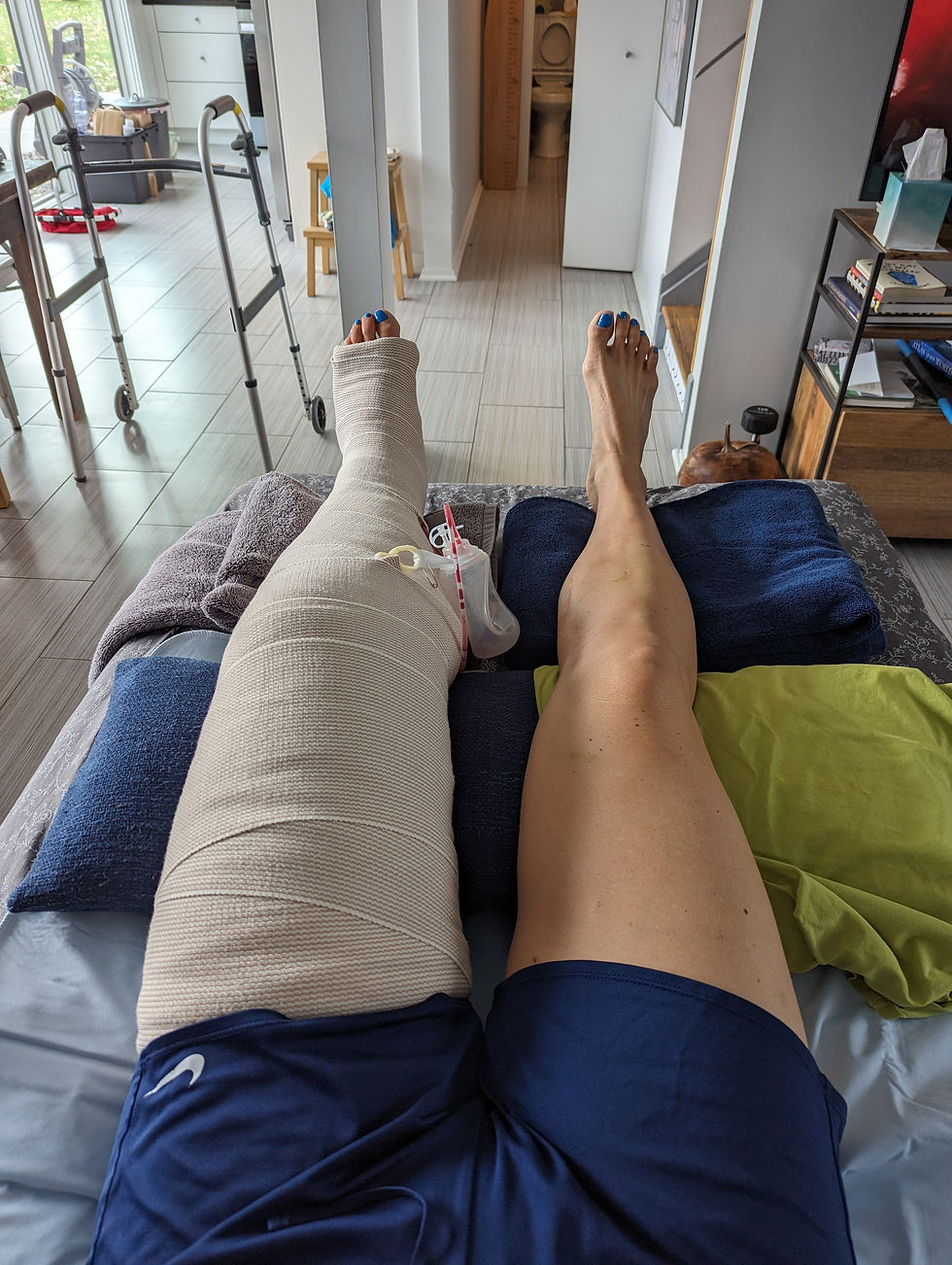
It's been 300 days since my surgery, and I still have not fully recovered. The nerves in my legs will take a long time to regenerate, and as they do, the muscles and mobility will slowly, painstakingly come back to life. I can’t do all the things that I would like to do, and I desperately want to be on the other side of this. It’s been about the same amount of time since I lost my dad, and a little bit longer than that since I lost my mom. It’s only when I look back at the shock that flooded my body at the news of my mom’s death; holding of my dad’s hand in his last days of Hospice care; the walker that gave way to a cane that gave way to a limp that gave way to a slow walk that turned, today, into a two-mile run—that I can see the healing progression. I reflect back and I can spot the tiny points along the way that keep propelling me forward, and I see the bravery, the strength, the grit, and the determination it takes to keep going when the waters of life turn rough.
BIO
Jeannette Stawski is the author of, “The Outdoor Leader” and currently serves as executive director for the Association of Outdoor Recreation and Education (AORE). She is a Certified Association Executive (CAE) and a Certified Executive Coach. She was the director of Outdoor Adventures at the University of Michigan for eleven years and has worked as a professional outdoor guide, a wilderness medicine instructor, and NOLS instructor. She is currently the chair of the Coalition for Outdoor Access (COA) and lives in Ann Arbor, Michigan with her husband and their two children.
Fall Issue '24 - Online Shop


